
Retinol or retinal – how do they differ and which one should you choose?
Both substances sound almost identical. Both belong to the vitamin A family. Both appear regularly on the labels of anti-wrinkle creams, serums and anti-aging products. And yet they are not the same, and the choice between them has a real impact on your skin. What exactly is the difference between retinol and retinal, how does each one work, and which will serve you better?
Before you compare: what are retinoids and how does vitamin A work in the skin?
Vitamin A is not a single ingredient, but a whole family of chemical compounds called retinoids. One thing unites them: they all aim for the same goal. Only one active form works in the skin – retinoic acid (tretinoin). It binds to the RAR receptors in the nuclei of skin cells and issues specific commands: produce more collagen, speed up cell turnover, calm inflammation, regulate sebum production.
The problem is that retinoic acid in its pure form would be too aggressive as a cosmetic ingredient, because it causes severe irritation, peeling and requires a prescription. That is why cosmetics use its precursors – forms that the skin must first process. The more conversion steps required, the slower and gentler a given retinoid acts. And this is where the difference between retinol and retinal begins.
Retinol – how it works and what sets this form of vitamin A apart
Retinol is vitamin A alcohol, the longest-used retinoid in cosmetology and one of the best-studied active ingredients in the history of dermatology. Before it can act in the skin, it must undergo two enzymatic conversions: first it transforms into retinal, and only then into active retinoic acid. It is precisely this two-step pathway that determines its characteristics.
On the one hand, this means slower action – you will usually notice the first results after 8–12 weeks of regular use. On the other hand, that same pathway is responsible for a higher potential for irritation, especially at the start of treatment. Redness, temporary peeling or skin hypersensitivity are not an allergy, but a reaction to accelerated cell renewal. It passes once the skin gets used to it.
In cosmetics you will find retinol in concentrations from 0.025% (an introduction to treatment) up to about 1% (advanced formulas). Regardless of the concentration, one rule applies: use it only in the evening, and always apply SPF sunscreen in the morning. Retinoids speed up epidermal renewal, which makes new cells more susceptible to UV damage.
Retinol works best for people with normal, dry or mature skin who already have experience with active products and want to build anti-aging results steadily.

Retinal – how does it work?
Retinal (retinaldehyde) is vitamin A aldehyde – a form standing one step closer to retinoic acid than retinol. It needs only a single enzymatic conversion to activate, which has practical consequences: it works faster, more effectively and at lower nominal concentrations.
Retinal concentrations in cosmetics are usually between 0.01% and 0.2%. This is not a mistake and not a weakness of the formula, but a deliberate choice stemming from its potency. Clinical studies show that 0.05% retinal achieves efficacy comparable to 0.05% tretinoin (pure retinoic acid), with a significantly lower risk of irritation. This is a result that retinol at a comparable concentration is unable to achieve.
Retinal also has something that retinol does not: antibacterial properties. It directly inhibits the growth of Cutibacterium acnes bacteria, responsible for the formation of acne. This mechanism works independently of the conversion to retinoic acid, so it offers real added value for people with acne-prone or combination skin. What’s more, retinal inhibits the activity of metalloproteinases, enzymes that destroy collagen and elastin in the skin’s aging process. So it works on two fronts: it builds and it protects.
The action mechanism of retinal is limited mainly to the keratinocytes of the epidermis, which means a lower risk of systemic irritation compared with the deeper-penetrating retinol. This is precisely why retinal is better tolerated by people with sensitive, couperose or reactive skin.
There is, however, one important detail that most articles keep quiet about: retinal is sensitive to oxidation. Contact with air and light quickly reduces its effectiveness. If you’re considering a product with retinal, check the packaging – it should be airtight (an airless pump) or in dark glass. Without the right formulation, even the best concentration won’t fulfill its role.
Retinol vs retinal – a comparison
Retinol or retinal: a summary of the key differences that will help you make an informed decision:
- Number of conversion steps to retinoic acid: Retinol needs two stages. Retinal needs one.
- Speed of action: Retinol gives first results after 8–12 weeks. Retinal works faster, with noticeable changes appearing earlier.
- Typical concentrations in cosmetics: Retinol: 0.025–1%. Retinal: 0.01–0.2%.
- Irritation potential: Retinol higher, especially at the start of treatment. Retinal lower, thanks to the shorter conversion pathway.
- Additional properties: Retinol: no documented antibacterial action. Retinal: confirmed action against C. acnes as well as inhibition of metalloproteinases.
- Formula stability: Retinol: moderate. Retinal: requires airtight packaging that protects against oxidation.
Neither is objectively better. It’s not a race, but two different tools for similar goals, with different profiles of action and tolerance.
Retinol or retinal – which to choose?
The answer to the question retinol or retinal depends on several factors: the condition of your skin, your experience with retinoids and what you expect from the treatment.
Just starting out with retinoids?
Start with retinal at a low concentration (0.01–0.05%) or retinol at 0.025–0.05%. Both are a safe entry into the world of vitamin A. The difference is that retinal will show the first results faster.
Do you have sensitive or couperose skin?
Retinal is the safer choice. A shorter conversion chain and action limited to keratinocytes mean a lower risk of reactions.
Are you struggling with acne?
Reach for retinal. Its antibacterial properties act directly on the bacteria responsible for inflammatory lesions – an advantage that retinol does not offer.
Do you have mature skin and experience with active ingredients?
Retinol in higher concentrations, or if you want to go a step further, the new-generation HPR retinoid.
And what about HPR – the new-generation retinoid that skips the entire conversion pathway?
Both retinol and retinal are precursors of retinoic acid – they require enzymatic conversion. HPR (hydroxypinacolone retinoate) works differently. It is an ester of retinoic acid that binds to the RAR receptors directly, without any intermediate metabolic steps. It doesn’t have to “become” active first, because it is active straight away.
What does this mean in practice? HPR works like retinoic acid, but without causing its typical irritation. The absence of metabolic conversion eliminates transient toxicity; the skin does not go through an adaptation phase with peeling or redness. Studies confirm that HPR provides a higher level of gene transcription than other retinoids at the same concentrations, markedly increases procollagen production, and is chemically more stable than both retinol and retinal.
For people with sensitive skin who until now had given up on retinoids because of irritation, HPR is often the first retinoid they can actually use without discomfort. It can also be combined with other active ingredients without the risk of overburdening the skin.
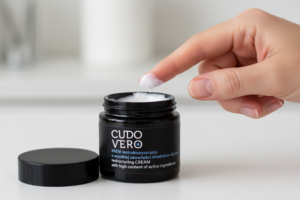
If you’d like to see how HPR works in practice – take a look at the formula of the CUDOVERO Restructuring Cream.
How to safely introduce a retinoid into your routine
Whether you choose retinol, retinal or HPR, the same rules of responsible introduction apply.
Start with a low frequency. During the first two weeks, use the retinoid every 2–3 days, not daily. Let the skin build tolerance instead of forcing it into immediate adaptation. The “sandwich” method is helpful – first apply a thin layer of a light moisturizer, then the retinoid, and finally moisturizer again. It’s a buffer that reduces potential irritation.
SPF every morning. This isn’t an option, it’s a must. Retinoids speed up epidermal renewal, which makes fresh cells more sensitive to UV radiation. Without sunscreen you lose part of the treatment’s benefits and risk discoloration.
Don’t combine retinoids in a single application step with AHA/BHA acids, pure vitamin C (ascorbic acid) or benzoyl peroxide. Each of these ingredients can intensify irritation. You can use them alternately – retinoids in the evening, acids on another day – but not at the same time.
When can you expect results? You may notice the first changes in texture and hydration after 2–4 weeks. Visible reduction of wrinkles and evening of skin tone after a minimum of 12 weeks of regular use. Retinoids are a marathon, not a sprint.
Retinol vs retinal – now you know
Retinol and retinal are two different roads leading to the same place, namely active vitamin A in your skin. Retinol acts more slowly, but it is very well studied and effective for skin that tolerates active ingredients. Retinal is faster, gentler and equipped with additional antibacterial properties – especially valuable for sensitive and acne-prone skin. If you want to go one step further, HPR eliminates enzymatic conversion entirely, combining the efficacy of retinoic acid with a safety profile that other retinoids cannot afford.
The choice doesn’t have to be difficult if you know what you’re looking for. A formula that tells the truth is the only basis for an informed decision. If you’re interested in how this looks in practice, check the formula of the CUDOVERO Restructuring Cream.
FAQ: Frequently asked questions
Are retinol and retinal the same thing?
No. Both substances belong to the retinoid family and are derivatives of vitamin A, but they are different chemical compounds. These ingredients have a different speed of action, different effective concentrations and a different tolerance profile.
Which is stronger – retinol or retinal?
Retinal works faster and more effectively at a lower nominal concentration, because it requires one enzymatic conversion instead of two. In this sense it is “stronger” at the same number of milligrams. This does not mean, however, that retinol is weak – at the right concentration and with regular use it achieves the same results. The strength of a retinoid in a product also depends on the entire formulation, not only on the type of substance.
Can retinal and retinol be used together?
There is no need for it and it is not recommended. Combining them does not enhance the effect, but it does increase the risk of irritation. Choose one form and use it consistently.
Can retinal be used in summer?
Yes, provided you use SPF sunscreen every morning – without exception. Retinoids speed up epidermal renewal, which makes the skin more sensitive to UV. Retinal, thanks to its lower irritation potential, is at the same time a safer choice for the warmer months than retinol in high concentrations.